

Nokia 4A0-AI1 Questions and Answers Guarantee you Oass the Test Easily
Share Latest 4A0-AI1 DUMP with 82 Questions and Answers
The Nokia 4A0-AI1 certification exam is an excellent opportunity for professionals who are looking to advance their careers in the field of network automation. With this certification, candidates can demonstrate their skills and knowledge to potential employers and stand out in a highly competitive job market.
The Nokia 4A0-AI1 certification exam is an advanced-level certification that requires a deep understanding of the NSP platform, network automation, and the latest industry trends. It is designed for professionals who are looking to validate their skills and knowledge in the field of network automation and distinguish themselves from their peers.
NEW QUESTION # 24
Which of the following is NOT a building block of NSP automation?
- A. Analytics & telemetry
- B. Model-driven mediation
- C. Multi-vendor support
- D. Terminal emulation configuration
Answer: D
Explanation:
Explanation
Terminal emulation configuration is not one of the building blocks of NSP automation. The building blocks of NSP automation are Model-driven mediation, Analytics & telemetry, Multi-vendor support and Automation scripting. Model-driven mediation enables the automation of common tasks across multiple vendors and devices, and analytics & telemetry enables the gathering of critical data to ensure service quality. Multi-vendor support enables the automation of tasks across multiple vendors, and automation scripting enables the development of robust and secure automation scripts.
NSP automation is based on four key building blocks:
* Model-driven mediation: This enables NSP to communicate with various network devices and protocols using a common data model and abstraction layer. It supports YANG models, NETCONF, RESTCONF, SNMP, TL1 and CLI2.
* Analytics & telemetry: This enables NSP to collect and analyze network data using streaming telemetry, SNMP polling, syslog and other methods. It supports various analytics applications such as Network Insight, Service Assurance and Traffic Engineering
* Multi-vendor support: This enables NSP to manage and automate networks that consist of devices from different vendors and technologies. It supports Nokia SROS devices as well as third-party routers, switches and optical equipment
* Programmable APIs: This enables NSP to expose its functionality and data to external applications or systems using RESTful APIs. It supports various use cases such as network supervision, service fulfillment, fault management and workflow management
NEW QUESTION # 25
Which of the following is NOT a characteristic of Infrastructurelure Intents?
- A. Policy management
- B. L2/L3 VPN configuration of multiple services
- C. System security
- D. Initial hardware configuration
Answer: B
Explanation:
Explanation
Infrastructure Lure Intents are a type of Network Intent that describe how network resources should be allocated and configured for a specific service or application.
L2/L3 VPN configuration of multiple services is NOT a characteristic of Infrastructure Lure Intents, because it is more related to service provisioning than resource allocation.
NEW QUESTION # 26
Which feature can be used to make a workflow portableif the workflow needs to be executed on either a development or production lab)?
- A. Conditional transactions
- B. Joining
- C. Forking
- D. Environments
Answer: D
Explanation:
Explanation
a workflow can use environments to make it portable if the workflow needs to be executed on either a development or production lab. Environments are files that contain key-value pairs that can be used as input parameters for workflows1. Environments allow workflows to be executed with different settings without modifying the workflow definition
NEW QUESTION # 27
Which of the following statements about the Nokia NSP is FALSE?
- A. It is the Source of Truth.
- B. It uses NETCONF and YANG to provision the network.
- C. It can act as a Path Computation Element (PCE).
- D. It only manages Nokia equipment.
Answer: D
Explanation:
Explanation
The Nokia NSP is an IP network automation platform that provides a unified view of the network and enables end-to-end automation of IP networks. It is designed to be vendor-agnostic and can manage a wide range of equipment from various vendors, making it the Source of Truth for the entire network. It uses NETCONF and YANG to provision the network and can act as a Path Computation Element (PCE).
Nokia NSP is a network automation platform that supports multi-vendor network infrastructure. It acts as the
"Source of Truth" for the network, uses NETCONF and YANG to provision the network, and can act as a Path Computation Element (PCE) to optimize traffic flow across the network. It supports a wide range of network devices, including those from third-party vendors, making it a flexible and vendor-agnostic solution for network automation.
some of the statements about the Nokia NSP are:
* It is a platform that provides service automation and network optimization across multiple network layers and domains.
* It uses NETCONF and YANG to provision the network and supports various protocols such as BGP-LS, PCEP, SNMP, etc.
* It can act as a Path Computation Element (PCE) and provide end-to-end path computation for traffic engineering applications.
* It can manage equipment from multiple vendors and supports open interfaces and standards.
http://nsp.developer.nokia.com/
https://www.nokia.com/networks/training/nsp/
NEW QUESTION # 28
Which of the following is NOT a benefit of ZTP?
- A. Minimizes the amount of commands typed
- B. Optimizes costs
- C. Lowers overall time for network rollout
- D. Increases network throughput
Answer: D
Explanation:
Explanation
The option that is NOT a benefit of ZTP (Zero Touch Provisioning) is:
Increases network throughput.
ZTP is a network device deployment method that automates the initial configuration process of network devices, eliminating the need for manual intervention. The benefits of ZTP include:
Lowers overall time for network rollout C. Optimizes costs D. Minimizes the amount of commands typed ZTP is a method of setting up devices that automatically configures the device using a switch feature. Another source2 mentions that ZTP helps IT teams quickly deploy network devices in a large-scale environment, eliminating most of the manual labor involved with adding them to a network. A third source3 explains that ZTP uses Cisco Plug and Play (Cisco PnP) to verify devices and perform downloads over a secure, encrypted channel.
NEW QUESTION # 29
Whatare the main sections of an abstract YANG module file?
- A. Structure and arguments
- B. Arguments and statements
- C. Structures and statements
- D. Arguments and leaves
Answer: B
Explanation:
Explanation
The main sections of an abstract YANG module file are arguments and statements.
An argument is a string that provides additional information about a statement. A statement is a keyword followed by an argument and optionally enclosed by braces ({ }) containing substatements.
For example, an abstract YANG module file could start with:
module ibn-intent { namespace "urn:nokia.com:ibn:intent"; prefix ibn;
This defines the module name, namespace and prefix as arguments for the module, namespace and prefix statements respectively.
NEW QUESTION # 30
Which of the following best describes an ad-hoc action?
- A. Default action provided by Workflow Manager
- B. Special action for NSP applications
- C. Can only be used by one workflow
- D. Wrapper around an existing system action
Answer: D
Explanation:
Explanation
Ad-hoc actions are wrappers around existing system actions that allow for more flexibility in terms of what can be done. They are not default actions provided by Workflow Manager, nor are they special actions for NSP applications. Ad-hoc actions can be used by multiple workflows.
NEW QUESTION # 31
Which of the following operations CANNOT be performed on an Intent?
- A. Audit
- B. Synchronize
- C. Phase-out
- D. Mark as misaligned
Answer: C
Explanation:
Explanation
some of the operations that can be performed on an Intent are:
* Create
* Synchronize
* Audit
* Update
* Delete
Therefore, based on this source, the answer that CANNOT be performed on an Intent is C. Phase-out.
NEW QUESTION # 32
Which of the following statements does NOT applyto YANG modules?
- A. Provides separation of configuration and state data
- B. Consists of containers and leaves
- C. Uses NETCONF and RE5TCONF to transport data
- D. Requires proprietary MIBS
Answer: D
Explanation:
Explanation
YANG modules do not require proprietary MIBS. YANG modules are used to define the structure and content of a network configuration and are written in a structured language that consists of containers and leaves.
YANG modules are used in conjunction with NETCONF and RESTCONF to transport data, and they provide a separation of configuration and state data.
NEW QUESTION # 33
What happens if you select "Modify" under "Behavior" in the WebUI and successfully modify anintent?
- A. The version number of the Intent is increased and multiple copies of the Intent are stored In the Intent Manager.
- B. The Intent is updated in the Intent Manager database and compared with the configuration on the target node.
- C. The Intent is updated in the Intent Manager database and synchronized.
- D. The Intent is updated in the Intent Manager database and no other actions are performed.
Answer: B
Explanation:
Explanation
According to the NSP Intent Manager Application Help12, if you select "Modify" under "Behavior" in the WebUI and successfully modify an intent, the intent is updated in the Intent Manager database and compared with the configuration on the target node. This will change the intended configuration for the audit and synchronize operations
NEW QUESTION # 34
Which of the following scripting languages can be used to extend WFM actions and expressions?
- A. Python
- B. Groovy
- C. PHP
- D. Perl
Answer: B
Explanation:
Explanation
According to the Nokia NSP Programmable Network Automation website , NSP API documentation and downloadable sample codes are available on the Nokia Network Developer Portal. The NSP Workflow Manager allows the design and management of workflows to automate network operations using Mistral DSL v2 which is based on YAML2. YAML definesexpressions in workflow and action definitions. The formatting of the YAML must comply with Mistral DSL v2 specifications3
NEW QUESTION # 35
Which of the following statements about the NSP Workflow Manager is FALSE?
- A. It uses Openstack Heat as the core workflow engine.
- B. It provides several building tools to design and create new workflows.
- C. It supports parallel execution of many workflow.
- D. It supports scheduling of workflow executions.
Answer: A
Explanation:
Explanation
According to the Nokia NSP Workflow Manager Application Help , Workflow Manager has the following characteristics:
* It provides several building tools to design and create new workflows. You can use graphical editors, text editors, or import existing workflows from files or repositories.
* It uses Openstack Mistral as the core workflow engine. Mistral is an open source project that provides a service for managing workflows across multiple cloud platforms.
* It supports scheduling of workflow executions. You can use cron expressions or triggers to specify when and how often a workflow should run.
* It supports parallel execution of many workflows. You can run multiple workflows simultaneously on different network elements or services.
Therefore, based on these sources, the correct answer is:
It uses Openstack Heat as the core workflow engine.
This is FALSE because Workflow Manager uses Openstack Mistral, not Heat, as the core workflow engine.
Heat is another open source project that provides a service for orchestrating multiple cloud applications using templates.
The other statements are TRUE because:
* It provides several building tools to design and create new workflows. This allows you to create workflows that suit your specific network needs and preferences.
* It supports scheduling of workflow executions. This allows you to automate recurring network tasks and optimize network performance and availability.
* It supports parallel execution of many workflows. This allows you to handle complex network scenarios and operations efficiently and effectively.
NEW QUESTION # 36
Which of the following protocols or standards is NOT used in Model Driven Telemetry?
- A. gRPC
- B. CLI
- C. NETCONF
- D. KAFKA
Answer: B
Explanation:
Explanation
CLI is not used in Model Driven Telemetry. Model Driven Telemetry is a technology that uses YANG data models, NETCONF, gRPC and KAFKA to monitor and collect data from network elements. It provides an abstracted view of the network element and is vendor agnostic.
Model Driven Telemetry is a method of collecting real-time data from network devices, allowing for more efficient network monitoring and troubleshooting. It uses a variety of protocols and standards, including NETCONF, gRPC, and Kafka. However, CLI is a text-based user interface used for issuing commands to a device, and it is not typically used for collecting telemetry data.
According to the Nokia Network Services Platform for industry and the public sector datasheet1, NSP model-driven telemetry framework supports the Nokia SR OS and third-party devices in configuring and collecting performance statistics using gRPC, SNMP, NETCONF and accounting files such as SAP QoS1. It also enables data to be persisted in a database and be made available (e.g., over a Kafka bus) for a variety of use cases1.
NEW QUESTION # 37
Based on the exhibit, which of the following is the proper syntax to publish ONLY information about the RTT to the workflow context?
A)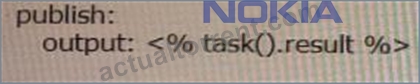
B)
C)
D)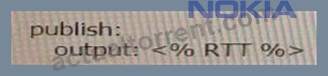
- A. Option B
- B. Option C
- C. Option A
- D. Option D
Answer: B
Explanation:
Explanation
This syntax assumes that there is a previous task that returns an object with an attribute named rtt that contains the round-trip time value1. The expression <% task().result.rtt %> evaluates to this value and assigns it to the variable rtt in the workflow context
NEW QUESTION # 38
What are the two main functionalities of the NSP REST API gateway services?
1. Versioning model
2. Create subscriptions
3. Location services
4. Authentication and termination services
- A. 1 and 4
- B. 1 and 2
- C. 2 and 3
- D. 3 and 4
Answer: A
Explanation:
Explanation
the NSP REST Gateway API provides the entry point for API clients to locate and authenticate REST client requests to gain access to the various NSP modules that have registered API services.
NEW QUESTION # 39
Which of the following statements about an intent is FALSE?
- A. It only involves services.
- B. It can be created and deleted through RESTCONF API.
- C. It is stored in the database as the source of truth.
- D. It is an instance of an intent type.
Answer: A
Explanation:
Explanation
According to the Nokia NSP Intent Manager Application Help2, an intent has the following characteristics:
* It is stored in the database as the source of truth.
* It is an instance of an intent type, which defines the structure and logic of an intent.
* It can be created and deleted through RESTCONF API or through the Intent Manager GUI.
* It can involve services, nodes, links, paths, or any other network elements.
NEW QUESTION # 40
Which of the following is NOT an NSP application?
- A. Service Fulfilment
- B. Network Virtualization
- C. IP/MPLS Optimization
- D. Network Supervision
Answer: C
Explanation:
Explanation
According to the Nokia NSP Learning and Certification Program2, there are four main NSP applications:
* Service Fulfillment: Enables service providers to design, create, and deliver IP/MPLS services across a multi-vendor network.
* Network Supervision: Provides real-time visibility and control of network performance, faults, and inventory across physical and virtual networks.
* IP/MPLS Optimization: Optimizes network resources by applying advanced algorithms and machine learning techniques to automate traffic engineering and path computation.
* Network Virtualization: Enables service providers to create and manage virtualized network functions (VNFs) and network slices using cloud-native technologies.
NEW QUESTION # 41
Which of the following is NOT a benefit of virtualization?
- A. Better scalability
- B. Software and hardware are tightly coupled
- C. Vendor agnostic
- D. Reduced capital and operating costs
Answer: B
Explanation:
Explanation
some of the benefits of virtualization are:
* Reduced capital and operating costs
* Better scalability
* Vendor agnostic
* Higher availability and resiliency
* Environmentally friendly
Virtualization enables decoupling of the software and hardware components, so that software can be deployed on any hardware platform without requiring the hardware to be specifically designed for the software. The other three options are all benefits of virtualization.
Software and hardware are tightly coupled is NOT a benefit of virtualization. Virtualization allows software to run independently of the hardware, enabling greater flexibility and scalability. This leads to reduced capital and operating costs, as well as vendor agnostic solutions.
NEW QUESTION # 42
Which of the following is NOT supported by the Workflow Manager out of the box?
- A. CLI command execution on SROS and third party routers
- B. Shell command execution
- C. REST/RESTCONF APIs
- D. Optical integration using TL1
Answer: B
Explanation:
Explanation
Workflow Manager is a module of Nokia NSP that allows users to create and execute automated procedures and closed loop automation using Nokia NSP or third party APIs . It uses Mistral as the workflow engine and supports various technologies that can be used in a workflow Some of the technologies that are supported by Workflow Manager out of the box are:
* REST/RESTCONF APIs
* CLI command execution on SROS and third party routers
* Optical integration using TL1
* SNMP traps
* Email notifications
NEW QUESTION # 43
Which of the following Kafka components represents a stream of messages of a particular category?
- A. Broker
- B. Producer
- C. Consumer
- D. Topic
Answer: D
Explanation:
Explanation
a Kafka topic is a channel where publishers (producers) publish data and where subscribers (consumers) receive data. A topic represents a stream of messages of a particular category.
In Kafka, a topic represents a stream of messages of a particular category or type. Producers publish messages to a specific topic, and consumers subscribe to and read messages from topics. Brokers are responsible for managing topics and ensuring that messages are distributed efficiently across the cluster.
NEW QUESTION # 44
Which of the following configures the network based on input provided by the user?
- A. Intent
- B. YANG module
- C. Framework files
- D. Intent Type
Answer: A
Explanation:
Explanation
Intent is a high-level description of the desired outcome or state of the network. It allows users to specify what they want to achieve rather than how to achieve it. The intent is then translated into network configurations and policies that are used to configure the network infrastructure. Intent-based networking provides a higher level of abstraction than traditional network configuration methods, making it easier for users to specify their requirements and automate the configuration process.
NEW QUESTION # 45
Which of the following is NOT an advantage of Software-Defined Networks (SDN) over traditional networks?
- A. An integrated control plane and data plane
- B. Applications communicate directly with the controller
- C. Greater agility in automating, monitoring, and provisioning network infrastructure
- D. Network logic is centrally integrated at the controller level
Answer: A
Explanation:
Explanation
An integrated control plane and data plane is NOT an advantage of Software-Defined Networks (SDN) over traditional networks. SDN separates the control plane from the data plane, enabling more efficient and flexible network management. By centralizing the network logic at the controller level, applications can communicate directly with the controller, allowing for greater agility in automating, monitoring, and provisioning network infrastructure.
some of the advantages of Software-Defined Networks (SDN) over traditional networks are:
* Traffic programmability
* Agility
* Policy-driven network supervision
* Network automation
* Centralized controller operations
* Decoupling of control plane from data plane
* Global view of network's state
NEW QUESTION # 46
Which of the following does NOT support Workflow actions?
- A. NSP applications
- B. UNIX servers
- C. Network elements
- D. Windows OS devices
Answer: D
Explanation:
Explanation
NSP Workflow Manager (WFM) is a module that allows users to create and execute automated procedures using NSP or third-party APIs. A workflow is a sequence of actions that can be performed on various targets such as:
* NSP applications: These are the applications that run on NSP such as Network Insight, Service Assurance, Traffic Engineering and others. They can be accessed by using RESTful APIs2.
* Network elements: These are the devices that are managed by NSP such as routers, switches and optical equipment. They can be accessed by using CLI, NETCONF, RESTCONF, SNMP or TL12.
* UNIX servers: These are the servers that run UNIX-based operating systems such as Linux or Solaris. They can be accessed by using SSH or SCP
NEW QUESTION # 47
......
The Nokia 4A0-AI1 certification exam is ideal for professionals who are looking to enhance their career in network automation and management. The certification is recognized globally, and it is highly valued by employers in the telecommunications industry. The exam is also suitable for individuals who are looking to acquire new skills and knowledge in network automation using NSP. The certification exam is designed to validate the candidate’s proficiency in the use of NSP for network automation, making them highly valuable in the job market.
Dumps for Free 4A0-AI1 Practice Exam Questions: https://www.actualtorrent.com/4A0-AI1-questions-answers.html