

2024 Current NSK101 dumps Preparation through Our Practice Test
100% Reliable Microsoft NSK101 Exam Dumps Test Pdf Exam Material
NEW QUESTION # 28
You want to block access to sites that use self-signed certificates. Which statement is true in this scenario?
- A. Certificate-related settings apply globally to the entire customer tenant.
- B. Self-signed certificates must be changed to a publicly trusted CA signed certificate.
- C. Certificate-related settings apply to each individual steering configuration level.
- D. Certificate-related settings apply to each individual client configuration level.
Answer: C
Explanation:
The statement that is true in this scenario is: Certificate-related settings apply to each individual steering configuration level. Certificate-related settings are the options that allow you to configure how Netskope handles SSL/TLS certificates for encrypted web traffic. For example, you can choose whether to allow or block self-signed certificates, expired certificates, revoked certificates, etc. You can also choose whether to enable SSL decryption for specific domains or categories. Certificate-related settings apply to each individual steering configuration level, which means that you can have different settings for different types of traffic or devices. For example, you can have one steering configuration for managed devices and another one for unmanaged devices, and apply different certificate-related settings for each one. This allows you to customize your security policies based on your needs and preferences. Reference: Netskope SSL DecryptionNetskope Steering Configuration
NEW QUESTION # 29
Your company asks you to obtain a detailed list of all events from the last 24 hours for a specific user. In this scenario, what are two methods to accomplish this task? (Choose two.)
- A. Export the data from Skope IT Alerts.
- B. Export the data from Skope IT Application Events.
- C. Use the Netskope REST API.
- D. Use the Netskope reporting engine.
Answer: B,C
Explanation:
In this scenario, there are two methods to obtain a detailed list of all events from the last 24 hours for a specific user. One method is to export the data from Skope IT Application Events, which is a feature in the Netskope platform that allows you to view and analyze all the activities performed by users on cloud applications. You can use filters to narrow down your search by user name, time range, application, activity, and other criteria. You can then export the data to a CSV or JSON file for further analysis or reporting. Another method is to use the Netskope REST API, which is a programmatic interface that allows you to access and manipulate data from the Netskope platform using HTTP requests. You can use the API to query for events by user name, time range, application, activity, and other parameters. You can then retrieve the data in JSON format for further analysis or integration with other tools. Using the Netskope reporting engine or exporting the data from Skope IT Alerts are not methods to obtain a detailed list of all events from the last 24 hours for a specific user, as they are more suited for generating summary reports or alerts based on predefined criteria or thresholds, rather than granular event data. Reference: [Netskope Skope IT Application Events], [Netskope REST API].
NEW QUESTION # 30
You want to use an out-of-band API connection into your sanctioned Microsoft 365 OneDrive for Business application to find sensitive content, enforce near real-time policy controls, and quarantine malware.
In this scenario, which primary function in the Netskope platform would you use to connect your application to Netskope?
- A. laaS API-enabled Protection
- B. Risk Insights
- C. SaaS API-enabled Protection
- D. DLP forensics
Answer: C
Explanation:
SaaS API-enabled Protection is a primary function in the Netskope platform that allows customers to connect their sanctioned SaaS applications to Netskope using out-of-band API connections. This enables customers to find sensitive content, enforce near real-time policy controls, and quarantine malware in their SaaS applications without affecting user experience or performance. If you want to use an out-of-band API connection into your sanctioned Microsoft 365 OneDrive for Business application to achieve these goals, you should use SaaS API-enabled Protection as the primary function in the Netskope platform. DLP forensics, Risk Insights, and IaaS API-enabled Protection are not primary functions in the Netskope platform that can be used to connect your application to Netskope. Reference: [Netskope SaaS API-enabled Protection].
NEW QUESTION # 31
What correctly defines the Zero Trust security model?
- A. multi-layered security
- B. strong authentication
- C. double encryption
- D. least privilege access
Answer: D
Explanation:
The term that correctly defines the Zero Trust security model is least privilege access. The Zero Trust security model is a modern security strategy based on the principle: never trust, always verify. Instead of assuming everything behind the corporate firewall is safe, the Zero Trust model assumes breach and verifies each request as though it originates from an open network. One of the core principles of the Zero Trust model is to use least privilege access, which means granting users or systems only the minimum level of access they need to perform their tasks, and only for a limited time. This helps reduce the attack surface and minimize the impact of a potential breach. Reference: Zero Trust Security - microsoft.comWhat is Zero Trust Security? Principles of the Zero Trust Model
NEW QUESTION # 32
What are two reasons why legacy solutions, such as on-premises firewalls and proxies, fail to secure the data and data access compared to Netskope Secure Web Gateway? (Choose two.)
- A. Legacy solutions are unable to see the user who is trying to access the application.
- B. The applications where the data resides are no longer in one central location.
- C. The users accessing this data are not in one central place.
- D. Legacy solutions do not meet compliance standards.
Answer: B,C
Explanation:
Legacy solutions, such as on-premises firewalls and proxies, fail to secure the data and data access compared to Netskope Secure Web Gateway because they are designed for a perimeter-based security model, where the applications and the users are both within the corporate network. However, with the rise of cloud computing and remote work, this model is no longer valid. The applications where the data resides are no longer in one central location, but distributed across multiple cloud services and regions. The users accessing this data are not in one central place, but working from anywhere, on any device. Legacy solutions cannot provide adequate visibility and control over this dynamic and complex environment, resulting in security gaps and performance issues. Netskope Secure Web Gateway, on the other hand, leverages a cloud-native architecture that provides high-performance and scalable inspection of traffic from any location and device, as well as granular policies and advanced threat and data protection for web and cloud applications. Reference: Netskope Architecture OverviewNetskope Next Gen SWG
NEW QUESTION # 33
What are two CASB inline interception use cases? (Choose two.)
- A. running a retroactive scan for data at rest in Google Drive
- B. blocking file uploads to a personal Box account
- C. using the Netskope steering client to provide user alerts when sensitive information is posted in Slack
- D. scanning Dropbox for credit card information
Answer: B,C
Explanation:
CASB inline interception use cases are scenarios where you need to apply real-time policies and actions on the traffic between users and cloud applications. For example, you may want to block file uploads to a personal Box account to prevent data leakage or exfiltration. You can use Netskope's inline proxy mode to intercept and inspect the traffic between users and Box, and apply granular policies based on user identity, device type, app instance, file metadata, etc. You can also use Netskope's inline proxy mode to provide user alerts when sensitive information is posted in Slack. For example, you may want to warn users when they share credit card numbers or social security numbers in Slack channels or messages. You can use Netskope's steering client to redirect the traffic between users and Slack to Netskope's inline proxy for inspection and enforcement. You can also use Netskope's DLP engine to detect sensitive data patterns and apply actions such as alerting or blocking. Reference: Netskope Inline Proxy ModeNetskope Steering Client [Netskope DLP Engine]
NEW QUESTION # 34
You just deployed the Netskope client in Web mode and several users mention that their messenger application is no longer working. Although you have a specific real-time policy that allows this application, upon further investigation you discover that it is using proprietary encryption. You need to permit access to all the users and maintain some visibility.
In this scenario, which configuration change would accomplish this task?
- A. Edit the steering configuration and add a steering exception for the messenger application.
- B. Change the real-time policy to block the messenger application.
- C. Create a new custom cloud application using the custom connector that can be used in the real-time policy.
- D. Add a policy in the SSL decryption section to bypass the messenger domain(s).
Answer: D
Explanation:
In this scenario, you have deployed the Netskope client in Web mode, which is a feature that allows you to steer your users' web traffic to Netskope for inspection and policy enforcement. However, some users report that their messenger application is no longer working, even though you have a specific real-time policy that allows this application. Upon further investigation, you discover that the messenger application is using proprietary encryption, which means that Netskope cannot decrypt or inspect the traffic from this application. To resolve this issue, you need to permit access to all the users and maintain some visibility. The configuration change that would accomplish this task is to add a policy in the SSL decryption section to bypass the messenger domain(s). This will allow Netskope to skip the decryption process for the traffic from the messenger application and pass it through without any modification. However, Netskope will still be able to log some basic information about the traffic, such as source, destination, bytes, etc., for visibility purposes. Changing the real-time policy to block the messenger application, creating a new custom cloud application using the custom connector, or editing the steering configuration and adding a steering exception for the messenger application are not configuration changes that would accomplish this task, as they would either prevent access to the application, require additional steps or resources, or reduce visibility. Reference: [Netskope Client], Netskope Security Cloud Operation & Administration (NSCO&A) - Classroom Course, Module 4: Decryption Policy.
NEW QUESTION # 35
There is a DLP violation on a file in your sanctioned Google Drive instance. The file is in a deleted state. You need to locate information pertaining to this DLP violation using Netskope. In this scenario, which statement is correct?
- A. You can find DLP violations under the Incidents dashboard.
- B. You must create a forensic profile so that an incident is created.
- C. You can find DLP violations under Forensic profiles.
- D. DLP incidents for a file are not visible when the file is deleted.
Answer: A
Explanation:
To locate information pertaining to a DLP violation on a file in your sanctioned Google Drive instance, you can use the Incidents dashboard in Netskope. The Incidents dashboard provides a comprehensive view of all the incidents that have occurred in your cloud environment, such as DLP violations, malware infections, anomalous activities, etc. You can filter the incidents by various criteria, such as app name, incident type, severity, user name, etc. You can also drill down into each incident to see more details, such as file name, file path, file owner, file size, file type, etc. The Incidents dashboard can show DLP violations for files that are in a deleted state, as long as they are still recoverable from the trash bin of the app. If the file is permanently deleted from the app, then the incident will not be visible in the dashboard. Reference: Netskope Incidents Dashboard
NEW QUESTION # 36
What are two characteristics of Netskope's Private Access Solution? (Choose two.)
- A. It acts as a cloud-based firewall.
- B. It requires on-premises hardware.
- C. It provides protection for private applications.
- D. It provides access to private applications.
Answer: C,D
NEW QUESTION # 37
You have applied a DLP Profile to block all Personally Identifiable Information data uploads to Microsoft 365 OneDrive. DLP Alerts are not displayed and no OneDrive-related activities are displayed in the Skope IT App Events table.
In this scenario, what are two possible reasons for this issue? (Choose two.)
- A. The destination domain is excluded from decryption in the decryption policy.
- B. A Netskope POP is not in your local country and therefore DLP policies cannot be applied.
- C. DLP policies do not apply when using IPsec as a steering option.
- D. The Cloud Storage category is in the Steering Configuration as an exception.
Answer: A,D
Explanation:
If the Cloud Storage category is in the Steering Configuration as an exception, then Netskope will not steer any traffic to or from cloud storage applications, such as Microsoft 365 OneDrive, to its platform. This means that Netskope will not be able to inspect or apply any policies to this traffic, including DLP policies. Similarly, if the destination domain is excluded from decryption in the decryption policy, then Netskope will not decrypt any traffic to or from that domain, such as onedrive.com. This means that Netskope will not be able to inspect or apply any policies to this traffic, including DLP policies. The location of the Netskope POP or the use of IPsec as a steering option do not affect the application of DLP policies, as long as Netskope can steer and decrypt the relevant traffic. Reference: Netskope Security Cloud Operation & Administration (NSCO&A) - Classroom Course, Module 3: Steering Configuration, Lesson 1: Steering Options and Lesson 2: Exceptions; Module 4: Decryption Policy, Lesson 1: Decryption Policy Overview and Lesson 2: Decryption Policy Configuration.: https://www.bsimm.com/ : https://www.iso.org/isoiec-27001-information-security.html : https://www.dasca.org/ : https://www.nist.gov/cyberframework
NEW QUESTION # 38
What is the limitation of using a legacy proxy compared to Netskope's solution?
- A. Legacy solutions offer higher performance and scalability for corporate and remote users.
- B. Netskope architecture requires on-premises components.
- C. To enforce policies, traffic needs to traverse back through a customer's on-premises security stack.
- D. Legacy on-premises solutions fail to provide protection for traffic from on-premises users.
Answer: C
Explanation:
A limitation of using a legacy proxy compared to Netskope's solution is that to enforce policies, traffic needs to traverse back through a customer's on-premises security stack. This creates latency, bandwidth, and scalability issues for remote users and cloud applications. Netskope's solution, on the other hand, leverages a cloud-native architecture that provides high-performance and scalable inspection of traffic from any location and device. Reference: [Netskope Architecture Overview]
NEW QUESTION # 39
You investigate a suspected malware incident and confirm that it was a false alarm.
- A. In this scenario, how would you prevent the same file from triggering another incident?
- B. Quarantine the file. Look up the hash at the VirusTotal website.
- C. Export the packet capture to a pcap file.
- D. Add the hash to the file filter.
Answer: D
Explanation:
A file filter is a list of file hashes that you can use to exclude files from inspection by Netskope. By adding the hash of the file that triggered a false alarm to the file filter, you can prevent it from being scanned again by Netskope and avoid generating another incident. Quarantining the file, exporting the packet capture, or looking up the hash at VirusTotal are not effective ways to prevent the same file from triggering another incident, as they do not affect how Netskope handles the file. Reference: Netskope Security Cloud Operation & Administration (NSCO&A) - Classroom Course, Module 6: Data Loss Prevention, Lesson 2: File Filters.
NEW QUESTION # 40
There is a DLP violation on a file in your sanctioned Google Drive instance. The file is in a deleted state. You need to locate information pertaining to this DLP violation using Netskope. In this scenario, which statement is correct?
- A. You can find DLP violations under the Incidents dashboard.
- B. You must create a forensic profile so that an incident is created.
- C. You can find DLP violations under Forensic profiles.
- D. DLP incidents for a file are not visible when the file is deleted.
Answer: A
Explanation:
To locate information pertaining to a DLP violation on a file in your sanctioned Google Drive instance, you can use the Incidents dashboard in Netskope. The Incidents dashboard provides a comprehensive view of all the incidents that have occurred in your cloud environment, such as DLP violations, malware infections, anomalous activities, etc. You can filter the incidents by various criteria, such as app name, incident type, severity, user name, etc. You can also drill down into each incident to see more details, such as file name, file path, file owner, file size, file type, etc. The Incidents dashboard can show DLP violations for files that are in a deleted state, as long as they are still recoverable from the trash bin of the app. If the file is permanently deleted from the app, then the incident will not be visible in the dashboard. Reference: Netskope Incidents Dashboard
NEW QUESTION # 41
You are working with traffic from applications with pinned certificates. In this scenario, which statement is correct?
- A. The domains used by certificate-pinned applications should be added to the authentication bypass list.
- B. Traffic with pinned certificates should be blocked.
- C. The domains used by applications with pinned certificates should be allowed in an inline policy.
- D. An exception should be added to the steering configuration.
Answer: D
Explanation:
When working with traffic from applications with pinned certificates, you should add an exception to the steering configuration to bypass them. Pinned certificates are a security technique that prevents man-in-the-middle attacks by validating the server certificates against a hardcoded list of certificates in the application. If you try to intercept or inspect the traffic from such applications, they will reject the connection or display an error message. Therefore, you should add the domains used by certificate-pinned applications as exceptions in your steering configuration, so that they are not steered to Netskope for analysis and enforcement. Reference: Certificate Pinned ApplicationsCreating a Steering Configuration
NEW QUESTION # 42
A customer asks you to create several real-time policies. Policy A generates alerts when any user downloads, uploads, or shares files on a cloud storage application. Policy B blocks users from downloading files from any operating system (OS) other than Mac or Windows for cloud storage. In this case, policy A is least restrictive and policy B is more restrictive.
Which statement is correct in this scenario?
- A. The policy order is not important; policies are independent of each other.
- B. Policy A is implemented before policy B.
- C. Policy B is implemented before policy A.
- D. These two policies would actually not work together.
Answer: C
Explanation:
In this scenario, policy B is more restrictive than policy A, as it blocks users from downloading files from any OS other than Mac or Windows for cloud storage, while policy A only generates alerts when any user downloads, uploads, or shares files on a cloud storage application. Therefore, policy B should be implemented before policy A, as the policy order determines the order of evaluation and enforcement of the policies. If policy A is implemented before policy B, then policy B will never be triggered, as policy A will match all the download activities for cloud storage and generate alerts. The policy order is important; policies are not independent of each other, as they may have overlapping or conflicting conditions and actions. These two policies would actually work together, as long as they are ordered correctly. Reference: Netskope Security Cloud Operation & Administration (NSCO&A) - Classroom Course, Module 5: Real-Time Policies, Lesson 3: Policy Order.
NEW QUESTION # 43
Exhibit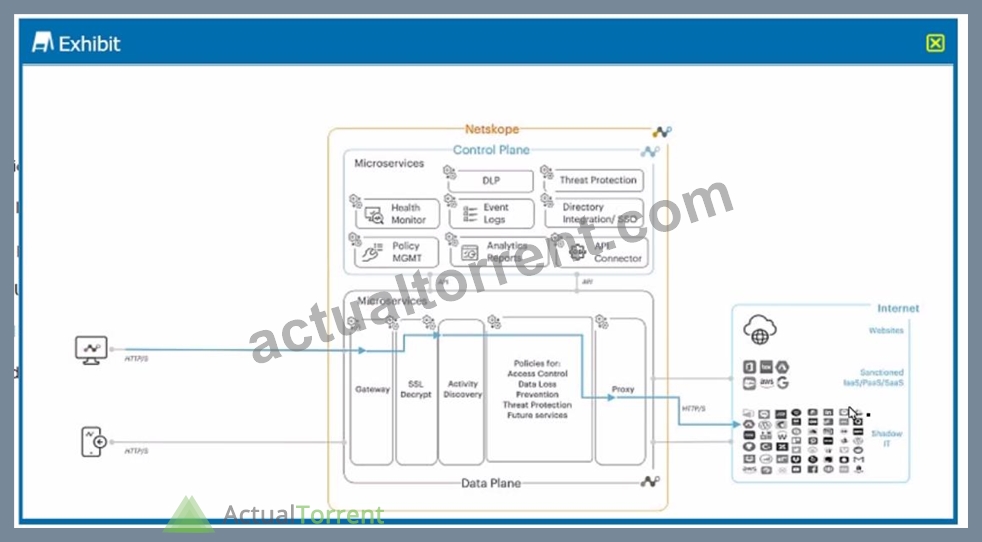
A user is connected to a cloud application through Netskope's proxy.
In this scenario, what information is available at Skope IT? (Choose three.)
- A. destination IP. OS patch version
- B. account instance, URL category
- C. file version, shared folder
- D. user activity, cloud app risk rating
- E. username. device location
Answer: B,D,E
Explanation:
In this scenario, a user is connected to a cloud application through Netskope's proxy, which is a deployment method that allows Netskope to intercept and inspect the traffic between the user and the cloud application in real time. In this case, Netskope can collect and display various information about the user and the cloud application at Skope IT, which is a feature in the Netskope platform that allows you to view and analyze all the activities performed by users on cloud applications. Some of the information that is available at Skope IT are: username, device location, account instance, URL category, user activity, and cloud app risk rating. Username is the name or identifier of the user who is accessing the cloud application. Device location is the geographical location of the device that the user is using to access the cloud application. Account instance is the specific instance of the cloud application that the user is accessing, such as a personal or enterprise instance. URL category is the classification of the web page that the user is visiting within the cloud application, such as Business or Social Media. User activity is the action that the user is performing on the cloud application, such as Upload or Share. Cloud app risk rating is the score that Netskope assigns to the cloud application based on its security posture and compliance with best practices. Destination IP, OS patch version, file version, and shared folder are not information that is available at Skope IT in this scenario, as they are either unrelated or irrelevant to the proxy connection or the Skope IT feature. Reference: [Netskope Inline CASB], [Netskope Skope IT].
NEW QUESTION # 44
You consume application infrastructure (middleware) capabilities by a third-party provider. What is the cloud service model that you are using in this scenario?
- A. DaaS
- B. SaaS
- C. MaaS
- D. PaaS
Answer: D
Explanation:
If you consume application infrastructure (middleware) capabilities by a third-party provider, then the cloud service model that you are using in this scenario is PaaS, which stands for Platform as a Service. PaaS is a cloud service model that provides customers with a platform to develop, run, and manage applications without having to deal with the underlying infrastructure or software. PaaS typically includes middleware capabilities such as databases, web servers, development tools, integration services, etc., that customers can use to build and deploy their applications faster and easier. MaaS, DaaS, and SaaS are not cloud service models that match this scenario, as they stand for different types of services. MaaS stands for Monitoring as a Service, which is a service that provides customers with tools to monitor and manage their cloud resources and performance. DaaS stands for Desktop as a Service, which is a service that provides customers with virtual desktops that they can access from any device or location. SaaS stands for Software as a Service, which is a service that provides customers with software applications that they can use over the internet without installing or maintaining them. Reference: [PaaS], [MaaS], [DaaS], [SaaS].
NEW QUESTION # 45
You want to enable Netskope to gain visibility into your users' cloud application activities in an inline mode.
In this scenario, which two deployment methods would match your inline use case? (Choose two.)
- A. Use a log parser.
- B. Use an API connector
- C. Use a reverse proxy.
- D. Use a forward proxy.
Answer: C,D
Explanation:
To enable Netskope to gain visibility into your users' cloud application activities in an inline mode, you need to use a deployment method that allows Netskope to intercept and inspect the traffic between your users and the cloud applications in real time. Two deployment methods that would match your inline use case are: use a forward proxy and use a reverse proxy. A forward proxy is a deployment method that allows Netskope to act as a proxy server for your users' outbound traffic to the internet. You can configure your users' devices or browsers to send their traffic to Netskope's proxy server, either manually or using PAC files or VPN profiles. A reverse proxy is a deployment method that allows Netskope to act as a proxy server for your users' inbound traffic from specific cloud applications. You can configure your cloud applications to redirect their traffic to Netskope's proxy server, either using custom URLs or certificates. Using an API connector or a log parser are not deployment methods that would match your inline use case, as they are more suitable for out-of-band modes that rely on accessing data and events from the cloud applications using APIs or logs, rather than intercepting traffic in real time. Reference: [Netskope Inline CASB], Netskope Security Cloud Operation & Administration (NSCO&A) - Classroom Course, Module 3: Steering Configuration, Lesson 4: Forward Proxy and Lesson 5: Reverse Proxy.
NEW QUESTION # 46
......
Free NSK101 Dumps are Available for Instant Access: https://www.actualtorrent.com/NSK101-questions-answers.html