

Get Dec-2025 updated 350-501 Certification Exam Sample Questions
350-501 Study Guide Cover to Cover as Literally
Cisco 350-501 exam is a comprehensive and challenging exam that requires a deep understanding of the service provider networking concepts and technologies. 350-501 exam consists of 90-110 questions, which must be completed within a time limit of 120 minutes. 350-501 exam is available in English and Japanese and can be taken at any Pearson VUE testing center worldwide.
Cisco 350-501 exam covers various topics, including network architecture, automation, virtualization, security, and quality of service. 350-501 exam is designed to test the candidate's understanding of the fundamental concepts and technologies used in service provider network solutions.
NEW QUESTION # 18
Refer to the exhibit: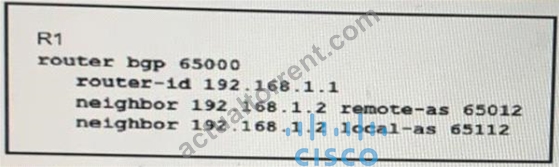
A network engineer is implementing a BGP protocol. Which effect of the locat-as keyword in this configuration is true?
- A. It enables peer 192.168.1.2 to establish a BGP relationship with R1 using AS 65112 and the VPNv4 address family
- B. It enables peer 192.168.1.2 to establish a BGP relationship with R1 using AS 65012 without additional configuration
- C. It enables peer 192.168.1.2 to establish a BGP relationship with R1 using AS 65112 without additional configuration.
- D. It enables peer 192.168.1.2 to establish a BGP relationship with R1 using AS 65012 and the VPNv4 address family
Answer: C
NEW QUESTION # 19
Refer to the exihibit.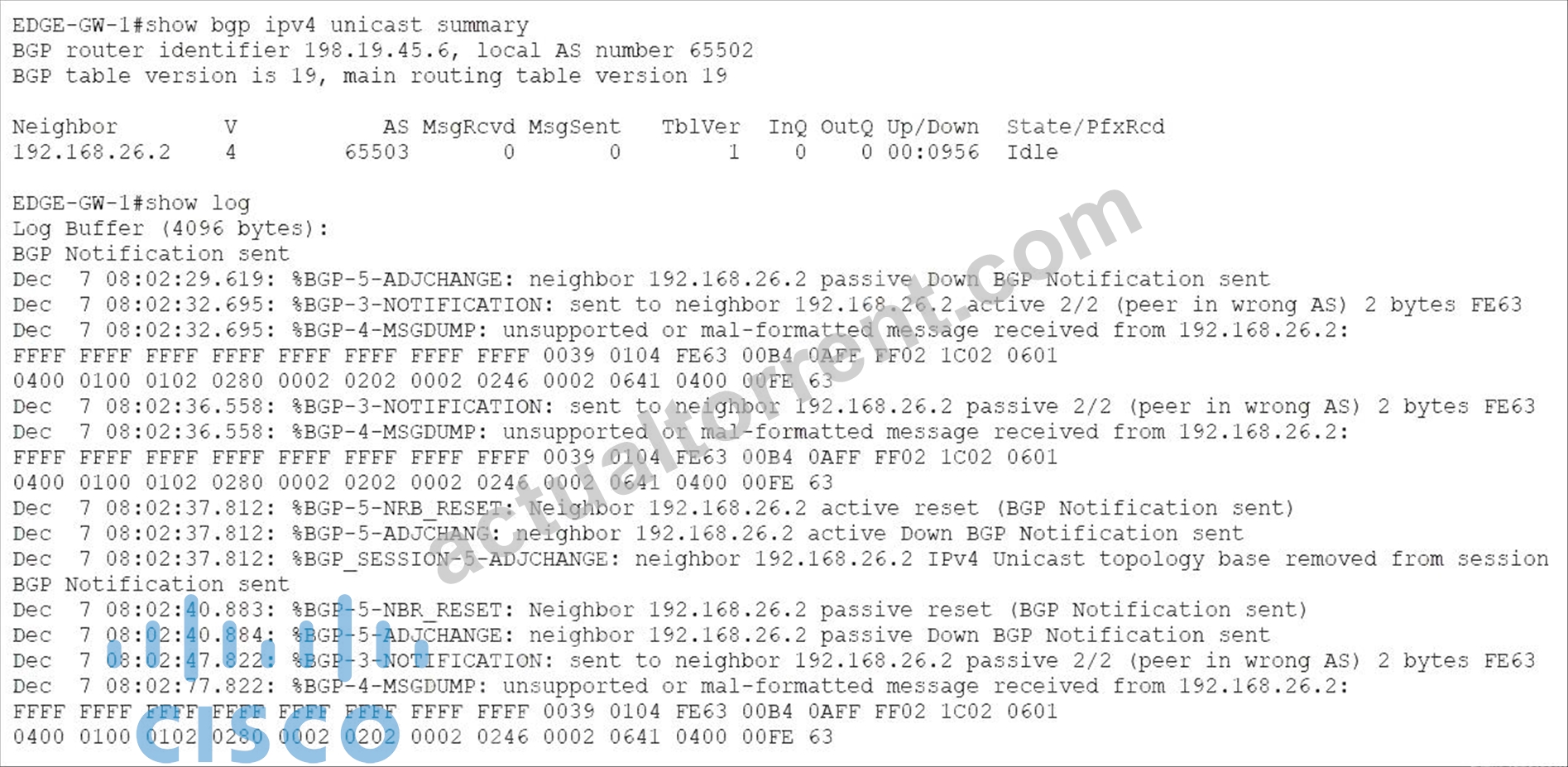
Refer to the exhibit. A network support engineer for ASN 65502 receives a technical support ticket from a customer in ASN 65503 who reports that an eBGP session is down. The engineer determines that the peering failed after a recent change to the device at 192.168.26.2. EDGE-GW-1 must establish an eBGP session with the peering router 192.168.26.2. Which configuration establishes this session?
- A. configure terminal
router bgp 65502
no neighbor 192.168.26.2 remote-as 65503
neighbor 192.168.26.2 remote-as 65123
address-family ipv4
neighbor 192.168.26.2 activate
end - B. configure terminal
router bgp 65502
address-family ipv4
neighbor 192.168.26.2 activate
end - C. configure terminal
no router bgp 65502
router bgp 65503
neighbor 192.168.26.2 remote-as 65503
address-family ipv4
neighbor 192.168.26.2 activate
end - D. configure terminal
no router bgp 65502
router bgp 65503
neighbor 192.168.26.2 remote-as 65123
address-family ipv4
neighbor 192.168.26.2 activate
end
Answer: B
NEW QUESTION # 20
Refer To the exhibit: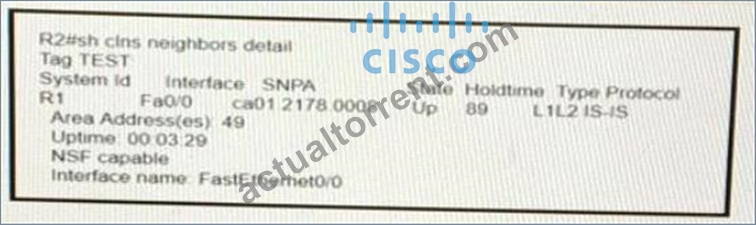
On R1, which output does the show isis neighbors command generate?
A)
B)
C)
D)
- A. Option A
- B. Option B
- C. Option D
- D. Option C
Answer: C
NEW QUESTION # 21
Refer to the exhibit. ISP A provides MPLS L3VPN service to customer A with BGP as the external routing protocol. Customer A has just opened a new branch office in London and requested the service provider to implement lossless service between its two offices. The LDP is enabled over the MPLS backbone and label exchange is working normally. Which action must the ISP engineering team take to enable the service?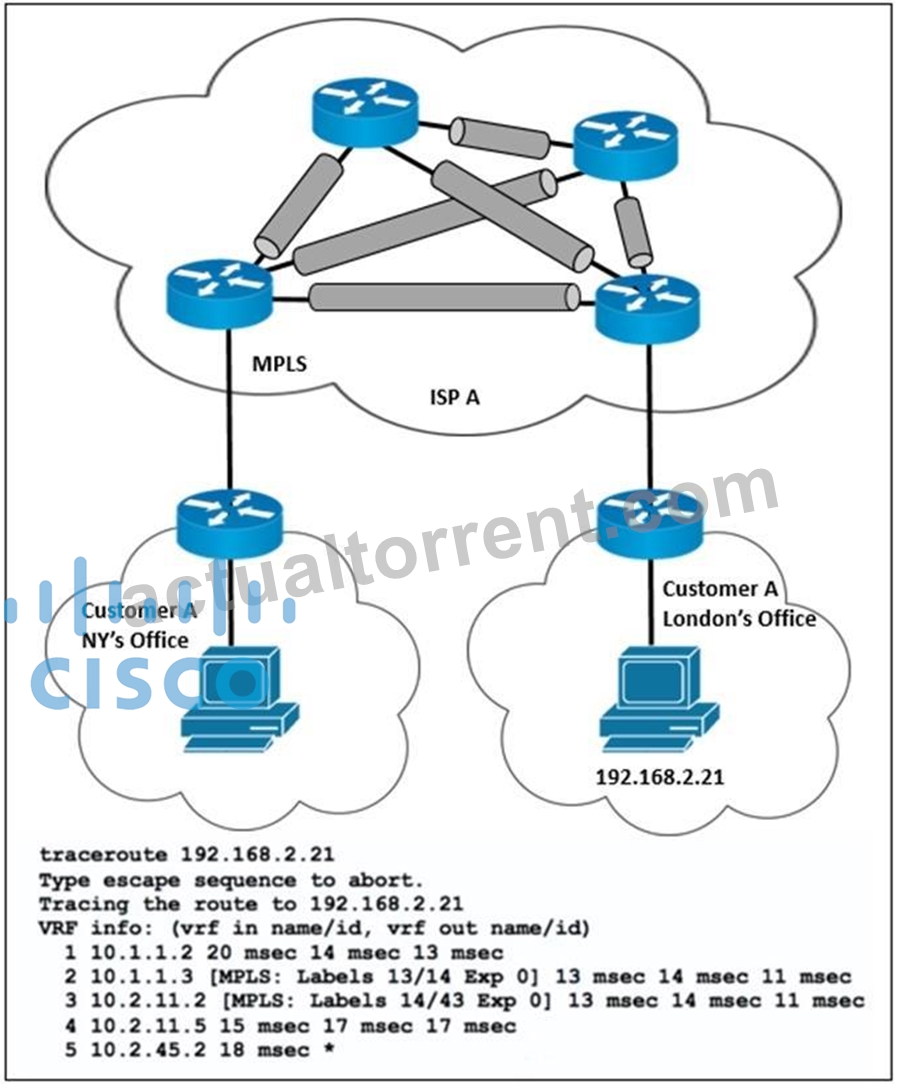
- A. Configure IGP and redistribute the route from BGP.
- B. Configure BGP address family VPNv4.
- C. Configure LDP and redistribute the route from EIGRP.
- D. Configure IGP LDP synchronization
Answer: D
NEW QUESTION # 22
Refer to the exhibit: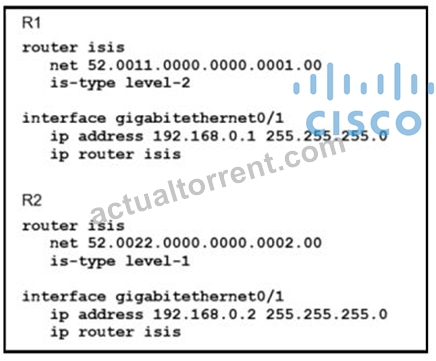
Which statement about the status of the neighbor relationship between R1 and R2 is true?
- A. The neighbor relationship is up because R2 is level 1 and level 2 router.
- B. The neighbor relationship is down because the two routers are configured with different area types
- C. The neighbor relationship is down because the two routers are in the same subnet.
- D. The neighbor relationship is down because R2 is operating as a Level 1 router and the two routers are in different area
Answer: D
NEW QUESTION # 23
Refer to the exhibit: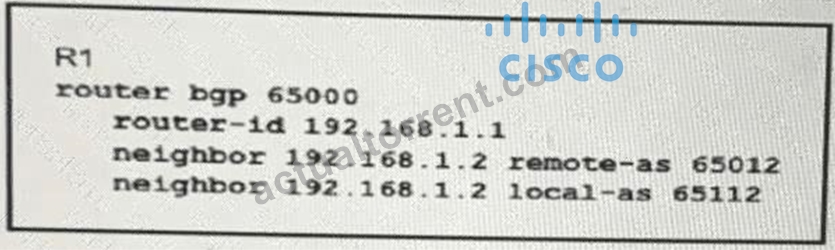
A network engineer is implementing a BGP protocol. Which effect of the local-as keyword in this configuration is true?
- A. It enables peer 192.168.1.2 to establish a BGP relationship with R1 using AS 65112 and the VPNv4 address family
- B. It enables peer 192.168.1.2 to establish a BGP relationship with R1 using AS 65012 without additional configuration
- C. It enables peer 192.168.1.2 to establish a BGP relationship with R1 using AS 65112 without additional configuration.
- D. It enables peer 192.168.1.2 to establish a BGP relationship with R1 using AS 65012 and the VPNv4 address family
Answer: C
Explanation:
The local-as keyword is used in BGP configurations to change the local AS number that is used in the BGP OPEN message when establishing a BGP session with a specific neighbor. In this case, even though the router is configured with AS 65000, it will use AS 65112 when establishing a connection with neighbor 192.168.1.2 due to the local-as keyword configuration. References := Cisco
https://www.cisco.com/c/en/us/support/docs/ip/border-gateway-protocol-bgp/13761-39.html
NEW QUESTION # 24
Refer to the exhibit.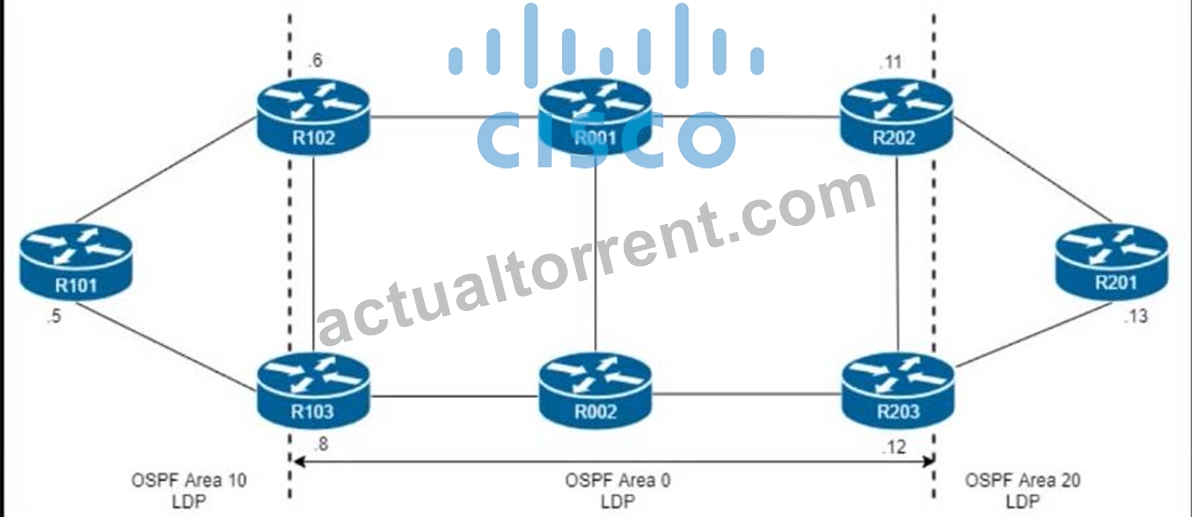
R101 is peering with R102 and R103, and R201 is peering with R202 and R203 using iBGP Labeled Unicast address families. The OSPF area 0 border routers are in a full iBGP Labeled Unicast mesh, and VPNv4 routes are exchanged directly between PE routers R101 and R201 through iBGP Which address family-level configuration must be applied on ABR R102 on ABR R102 to support a Unified MPLS routing architecture with partitioned IGP domains?
A)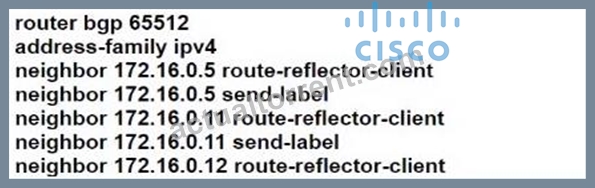
B)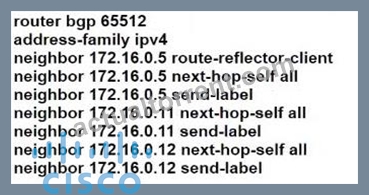
C)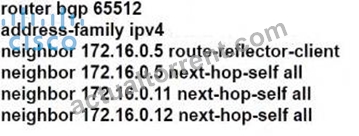
D)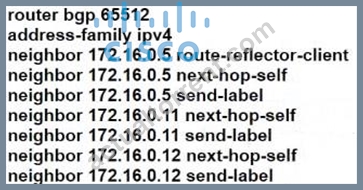
- A. Option A
- B. Option B
- C. Option D
- D. Option C
Answer: B
NEW QUESTION # 25
Refer to the exhibit.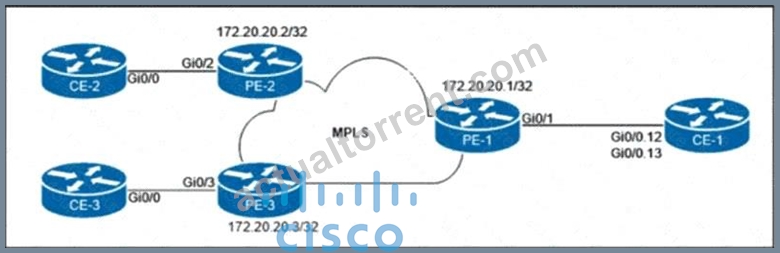
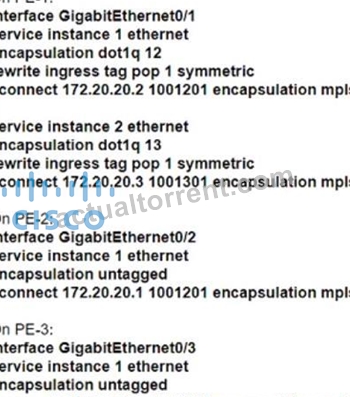
The customer that owns the CE-1, CE-2, and CE-3 routers purchased point-to-point E-Line services from the Carrier Ethernet provider. The service provider is delivering multiplexed UNI at the customer HQ location on PE-1 and untagged UNIs at the PE-2 and PE-3 locations. Additionally, the customer provided these VLAN to EVC mapping requirements:
* EVC 1 between CE-1 and CE-2 must be provisioned with C-VLAN 12 at the HQ location.
* EVC 2 between CE-1 and CE-3 must be provisioned with C-VLAN 13 at the HQ location.
Which configuration must the network engineer implement on the PE routers to provide end-to-end Carrier Ethernet service to the customer?
- A.
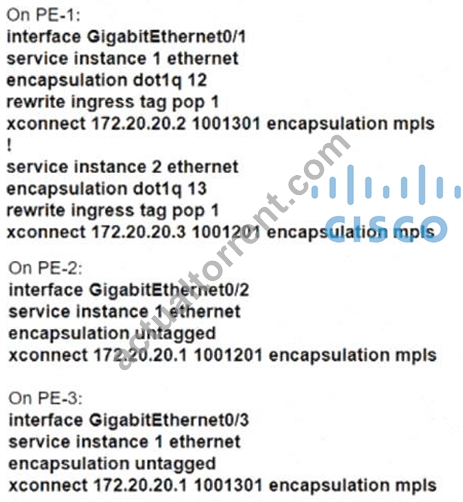
- B.
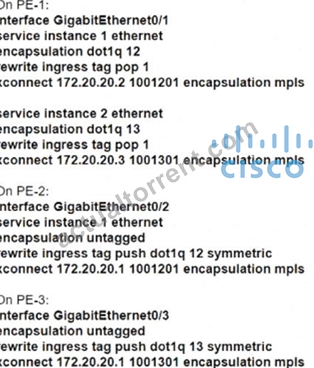
- C.
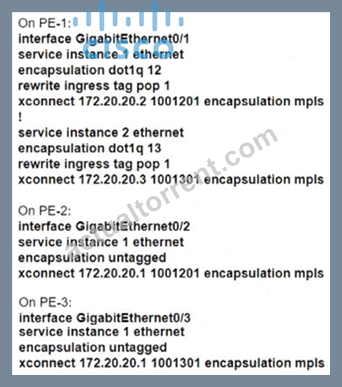
- D.
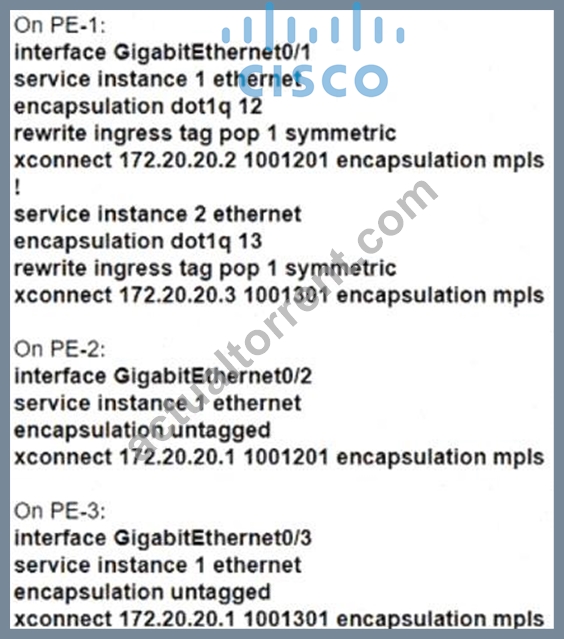
Answer: B
NEW QUESTION # 26
What is a characteristic of MVPN?
- A. It allows VRF traffic to use the service provider MPLS VPN to route multicast traffic.
- B. It uses pseudowires to route unicast and broadcast traffic over either a service provider MPLS or IP core.
- C. It bypasses the use of MPLS in the service provider core and transmits packets using IP only.
- D. It creates GRE tunnels to route multicast traffic over a service provider IP core.
Answer: A
NEW QUESTION # 27
Refer to the exhibit: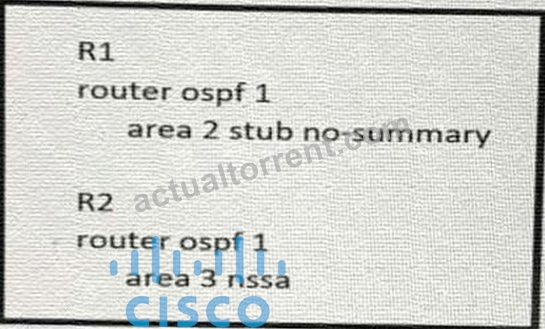
In which way does router R1 operate differently than router R2?
- A. R1 sends LSA type 2 only and R2 sends LSA type 1 only
- B. R1 sends LSA types 5 and 7, while R2 sends type 1, 2, and 7 LSAs
- C. R1 sends LSA type 2 only, while R2 sends type 1 and type 7 LSAs
- D. R1 sends LSA types 1 and 2, while R2 sends type 1. 2. and 7 LSAs
Answer: D
Explanation:
Router R1 is configured as a stub area with the "no-summary" option, which means it will not receive summary LSAs (Type 3) from the Area Border Router (ABR). It will only have Type 1 (Router LSAs) and Type 2 (Network LSAs) in its OSPF database for the area it belongs to. Router R2 is configured as an NSSA (Not So Stubby Area), which allows it to import AS external routes as Type-7 LSAs. These Type-7 LSAs can then be converted to Type-5 LSAs by the ABR when propagated into other areas. Therefore, R2 has Types 1,
2, and 7 LSAs in its OSPF database.
For more detailed information, please refer to the Implementing and Operating Cisco Service Provider Network Core Technologies (SPCOR) course materials, specifically the sections covering OSPF area types and LSA types.
NEW QUESTION # 28
Refer to the exhibit. A network engineer with an employee ID: 5086:72:817 is configuring a connection to manage CE1 from the OAM server on VLAN 100. PE1 must push S-VLAN tag 10 toward PE2 while forwarding traffic from CE1 to the OAM server. PE1 must push S-VLAN tag 20 toward PE2 while forwarding traffic from CE2 to the data traffic gateway. Which configuration must the engineer implement on PE2?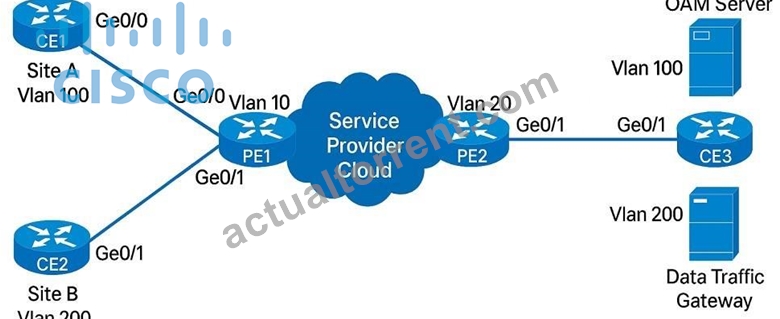
- A. Interface Ge0/0
encapsulation dot1q 100
rewrite ingress tag push dot1q 10 symmetric
Interface Ge0/1
encapsulation dot1q 200
rewrite ingress tag push dot1q 20 symmetric - B. Interface Ge0/1
encapsulation dot1q 10
rewrite ingress tag push dot1q 10 symmetric
Interface Ge0/0
encapsulation dot1q 20
rewrite ingress tag push dot1q 20 symmetric - C. Interface Ge0/1
encapsulation dot1q 100
rewrite ingress tag translate 1-to-1 dot1q 20 - D. Interface Ge0/1
encapsulation dot1q 100
rewrite ingress tag pop 10
rewrite ingress tag push 20
Answer: C
Explanation:
On PE2 you must map the incoming S-VLAN tags directly into the CE-VLAN. The one-to-one translate command does exactly that - any packet arriving with S-VLAN-20 is rewritten into C-VLAN-100 on the CE-facing subinterface.
PE2(config)# interface GigabitEthernet0/1
PE2(config-if)# encapsulation dot1q 100
PE2(config-if)# rewrite ingress tag translate 1-to-1 dot1q 20
This ensures that traffic PE1 has S-tagged with 20 (from CE2) is presented to the CE3/OAM server on VLAN-100.
NEW QUESTION # 29
When Cisco lOS XE REST API uses HTTP request methods what is the purpose of a PUT request?
- A. retrieves the specified resource or representation
- B. creates a new resource
- C. submits data to be processed to the specified resource
- D. updates the specified resource with new information
Answer: D
Explanation:
NEW QUESTION # 30
Which statement about the Cisco MPLS TE forwarding adjacency feature is true?
- A. It enables the headend and tailend routers to establish a bidirectional tunnel
- B. It enables the tailend router to advertise routes to the headend router over the tunnel
- C. It enables the MPLS core to use EIGRP as the routing protocol
- D. It enables the Cisco MPLS TE tunnel to be advertised into the running IGP.
Answer: D
Explanation:
The Cisco MPLS TE forwarding adjacency feature allows a TE tunnel to be advertised into the IGP, effectively making the tunnel appear as a network link in the IGP topology. This integration helps in the optimal utilization of the TE tunnel by other routers for IP routing purposes.
NEW QUESTION # 31
Refer to the exhibit: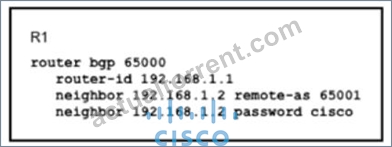
Router R1 and its peer R2 reside on the same subnet in the network, If does it make connections to R27
- A. R1 establishes UDP connections that are authenticated with a clear-text password
- B. R1 establishes UDP connections that are authenticated with an MD5 password
- C. R1 establishes TCP connections that are authenticated with an MD5 password
- D. R1 establishes TCP connections that are authenticated with a clear-text password
Answer: C
Explanation:
Router R1 establishes TCP connections that are authenticated with an MD5 password. In the context of BGP (Border Gateway Protocol), TCP is used for establishing connections, and MD5 passwords can be used for authentication to enhance security.
NEW QUESTION # 32
What is the function of the FEC field within the OTN signal structure?
- A. It allows deep inspection of data payload fields.
- B. It allows receivers to correct errors upon data arrival.
- C. It allows the sending devices to apply QoS within the OTN forwarding structure.
- D. It allows source nodes to discard payload errors before transmitting data on the network.
Answer: B
NEW QUESTION # 33
How is a telemetry session established for data analytics?
- A. The destination initiate a session using the dial-out more to the router.
- B. A router initiates a session using the dial-out to a destination.
- C. A destination initiate a session to a router.
- D. A router requests the data using Teinet.
Answer: C
Explanation:
In the context of telemetry for data analytics, a destination (such as a collector or monitoring system) initiates a session to a router. This session allows the router to send telemetry data to the destination for analysis.
NEW QUESTION # 34
Which task must be performed first to Implement BFD in an IS-IS environment?
- A. Disable Cisco Express Forward.ng on all interfaces running routing protocols other than IS-IS
- B. Configure BFD in an interface configuration mode
- C. Configure BFD under the IS-IS process
- D. Configure all ISIS routers as Level 2 devices
Answer: C
NEW QUESTION # 35
Refer to the exhibit.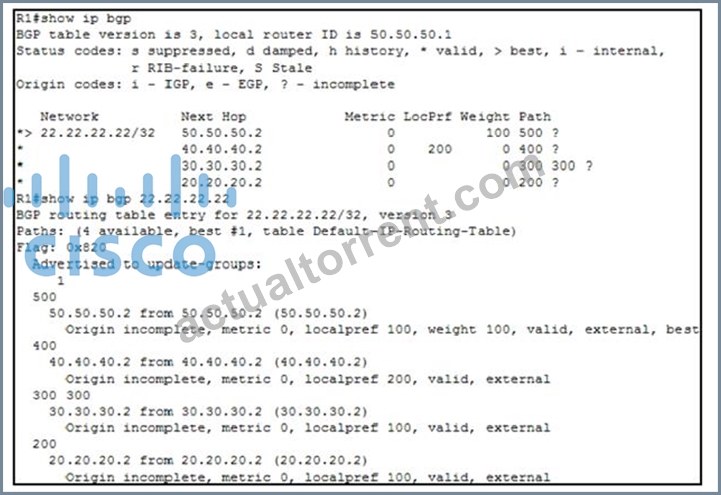
An engineer wants to determine which paths are best, second best, third best, and fourth best. Drag and drop the peer addresses on the left to the corresponding BGP best-path selection order on the right.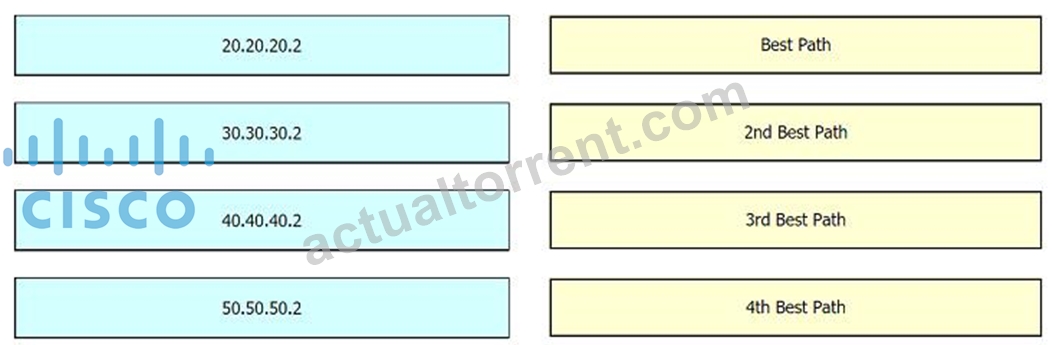
Answer:
Explanation: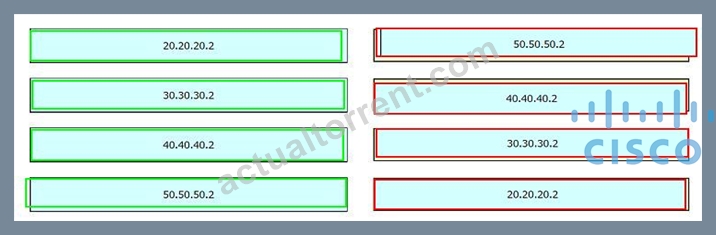
NEW QUESTION # 36
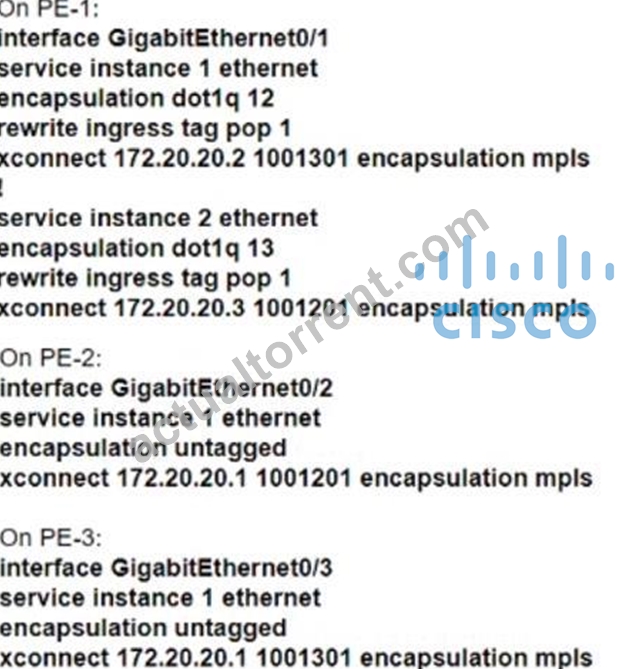
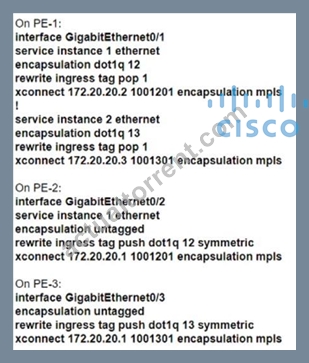
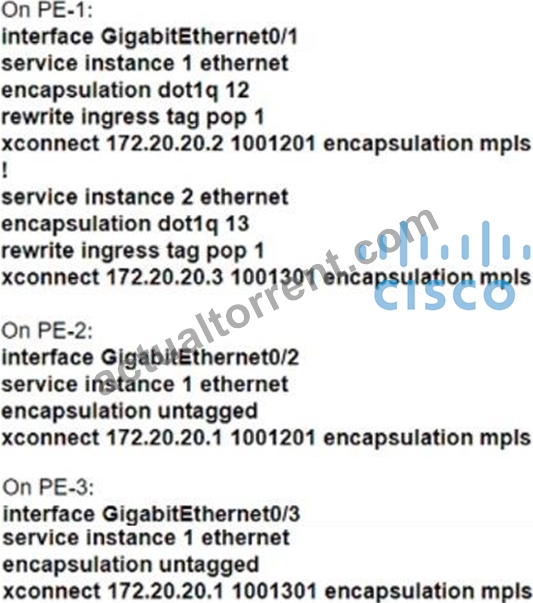
Refer to the exhibit. The customer that owns the CE-1, CE-2, and CE-3 routers purchased point- to-point E-Line services from the Carrier Ethernet provider. The service provider is delivering multiplexed UNI at the customer HQ location on PE-1 and untagged UNIs at the PE-2 and PE-3 locations. Additionally, the customer provided these VLAN to EVC mapping requirements:
- EVC 1 between CE-1 and CE-2 must be provisioned with C-VLAN 12 at the HQ location.
- EVC 2 between CE-1 and CE-3 must be provisioned with C-VLAN 13 at the HQ location.
Which configuration must the network engineer implement on the PE routers to provide end-to- end Carrier Ethernet service to the customer?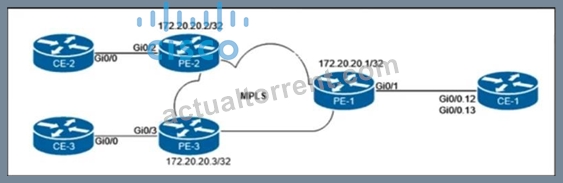
- A.
- B.
- C.
- D.
Answer: C
NEW QUESTION # 37
Refer to the exhibit. An engineer is configuring IS-IS on ISP network. Which IS-IS configuration must an engineer implement on router AGG1 so that it establishes connectivity to router AGG6 via the BB3 core router?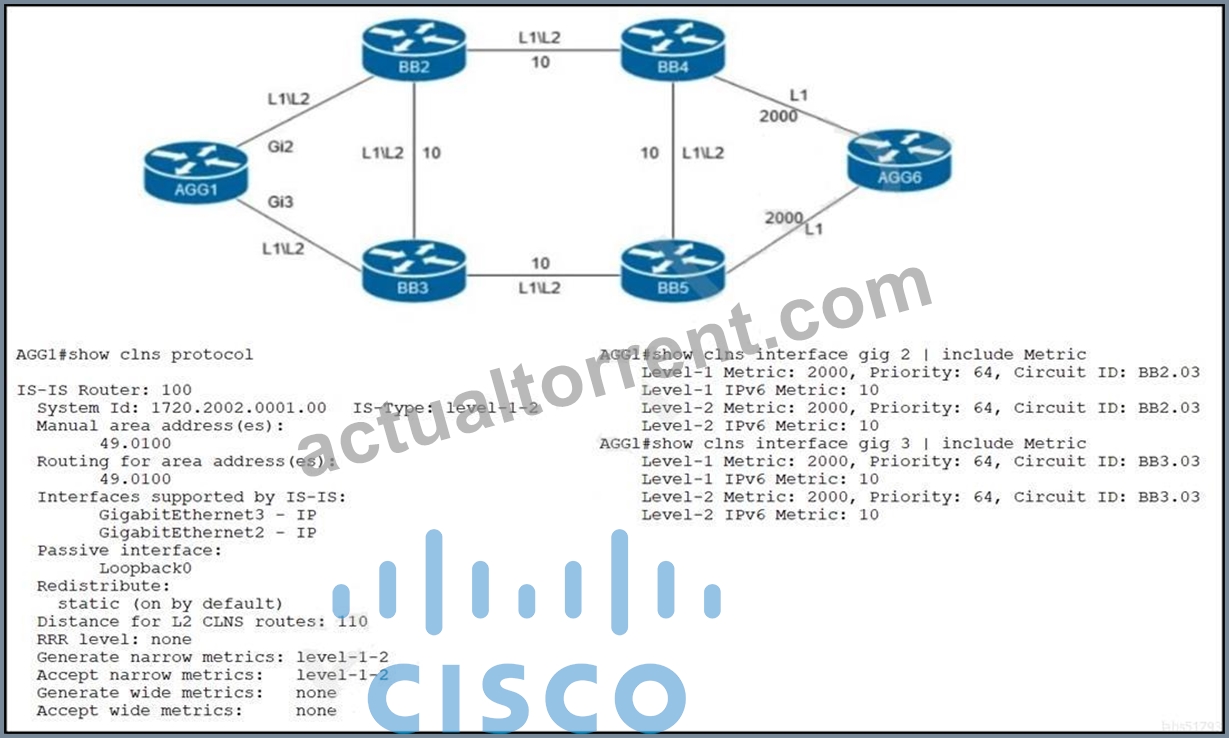
- A. router isis 100
metric-style narrow
interface GigabitEthernet 3
isis metric 10 level-1 - B. router isis 100
metric-style wide
interface GigabitEthernet 3
isis metric 1500 level-2 - C. router isis 100
metric-style narrow
interface GigabitEthernet 3
isis metric 10 level-2 - D. router isis 100
metric-style wide
interface GigabitEthernet 3
isis metric 1500 level-1
Answer: A
NEW QUESTION # 38
Refer to the exhibit: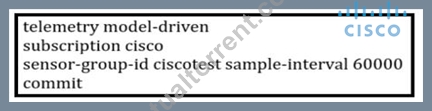
This configuration is being applied on an IOS XR router.
Which statement about this configuration is true?
- A. It is used to create a streaming subscription with a 600-second interval
- B. It is used to create a streaming subscription with a 60-second interval
- C. It is used to set up configuration to poll network data
- D. It is used to enable gRPC
Answer: B
NEW QUESTION # 39 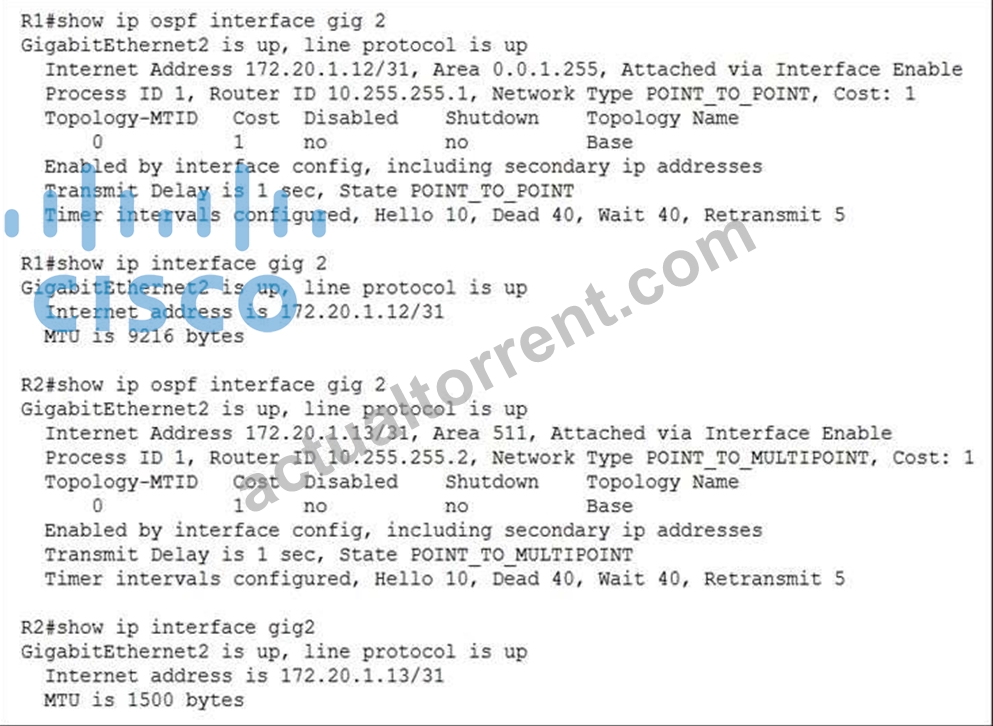
Refer to the exhibit. While troubleshooting the OSPF adjacency between routers R1 and R2, an engineer noticed that both routers are stuck in the EXCHANGE/EXSTART state. What should the engineer fix to solve the ongoing issue?
- A. match IPv4 addresses
- B. match OSPF areas
- C. match OSPF network types
- D. match MTU values
Answer: D
Explanation:
Section: Networking
NEW QUESTION # 40
......
Cisco 350-501 exam is an essential certification for professionals looking to demonstrate their expertise in service provider networking and advance their careers in this field. Implementing and Operating Cisco Service Provider Network Core Technologies certification is recognized worldwide and is highly valued by employers in the networking industry. Implementing and Operating Cisco Service Provider Network Core Technologies certification also provides a pathway to higher-level certifications, such as the CCIE Service Provider certification.
100% Real & Accurate 350-501 Questions and Answers with Free and Fast Updates: https://www.actualtorrent.com/350-501-questions-answers.html
Get Unlimited Access to 350-501 Certification Exam Cert Guide: https://drive.google.com/open?id=1K8I0KxyfTe1s_LeS-SQARYBJKD_66nTr